
Cassia County Arrest Records and Court Charges
Arrest records in Cassia County start on the sheriff and jail side. Sheriff Jarrod Thompson's office lists the Cassia County Sheriff's Office at 129 East 14th Street in Burley, with dispatch at 208-878-2251, administration at 208-878-1002, and records at 208-878-1107. When a person is booked into the Mini-Cassia Criminal Justice Center, the public jail materials may show the booking date and time, name, sex, race, age, booking identifier, agency, case number, and bond amount.
The court charge record is narrower than a full criminal case file but more formal than a booking note. After law enforcement refers an arrest or investigation, the Cassia County Prosecuting Attorney decides what charges to file and prosecute. McCord Larsen is listed as Prosecuting Attorney, with Anthony T. Fry as Chief Deputy Prosecutor and Timothy J. Schneider as Deputy Prosecutor. Filed charges move into the District Court or Magistrate Division record at the Cassia County Judicial Center, 1559 Overland Ave, Burley, phone 208-878-7351.
The county's recent bookings page is the most direct public source for arrest-adjacent charge listings. It shows booking date and time, name, demographic fields, charge code or statute, charge description, and the offense level, such as felony or misdemeanor.
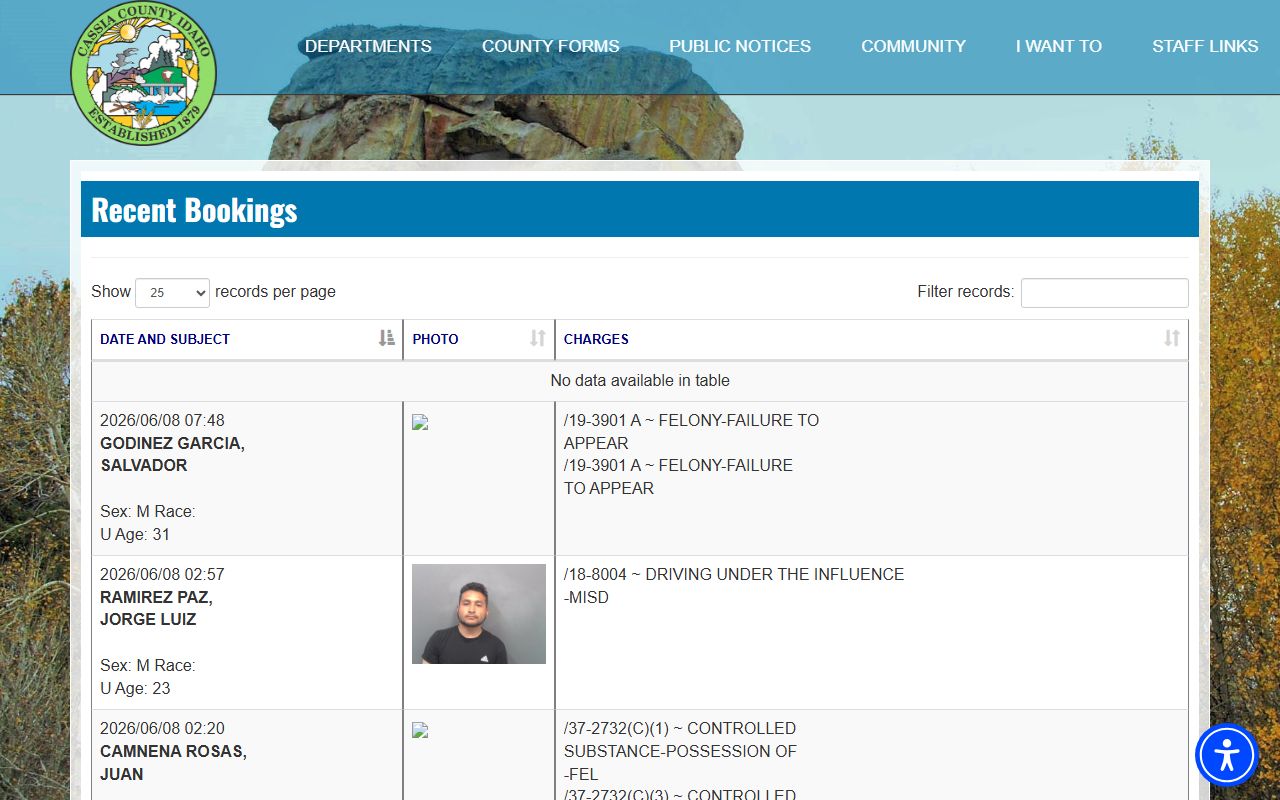
Those booking fields are useful for identifying the arrest event, but the official court case should still be checked through iCourt or the clerk because charges can be amended, reduced, dismissed, or replaced after booking.
How to Find Cassia County Arrest Records and Charges
Start with the custody source when the question is whether someone was recently booked or held. Use the Cassia County jail roster for current custody and the recent-bookings page for new booking entries. The roster is a browse list rather than a form search, and the Mini-Cassia page warns that jail data should not be relied on for legal action because status changes may not appear immediately.
- Open the jail roster or recent bookings page from the Cassia County courts and law enforcement links.
- Match the person by name, age, booking date, agency, and booking identifier rather than by one field alone.
- Note the charge code, charge description, offense level, case number, and bond line when shown.
- Search the Idaho iCourt Portal from iCourt by defendant name or case number to follow the filed court charge.
- Request copies from the Clerk of the District Court if the public portal does not show the needed document.
The jail roster page adds case numbers, court or county labels, agencies, and bond amounts to the custody picture.
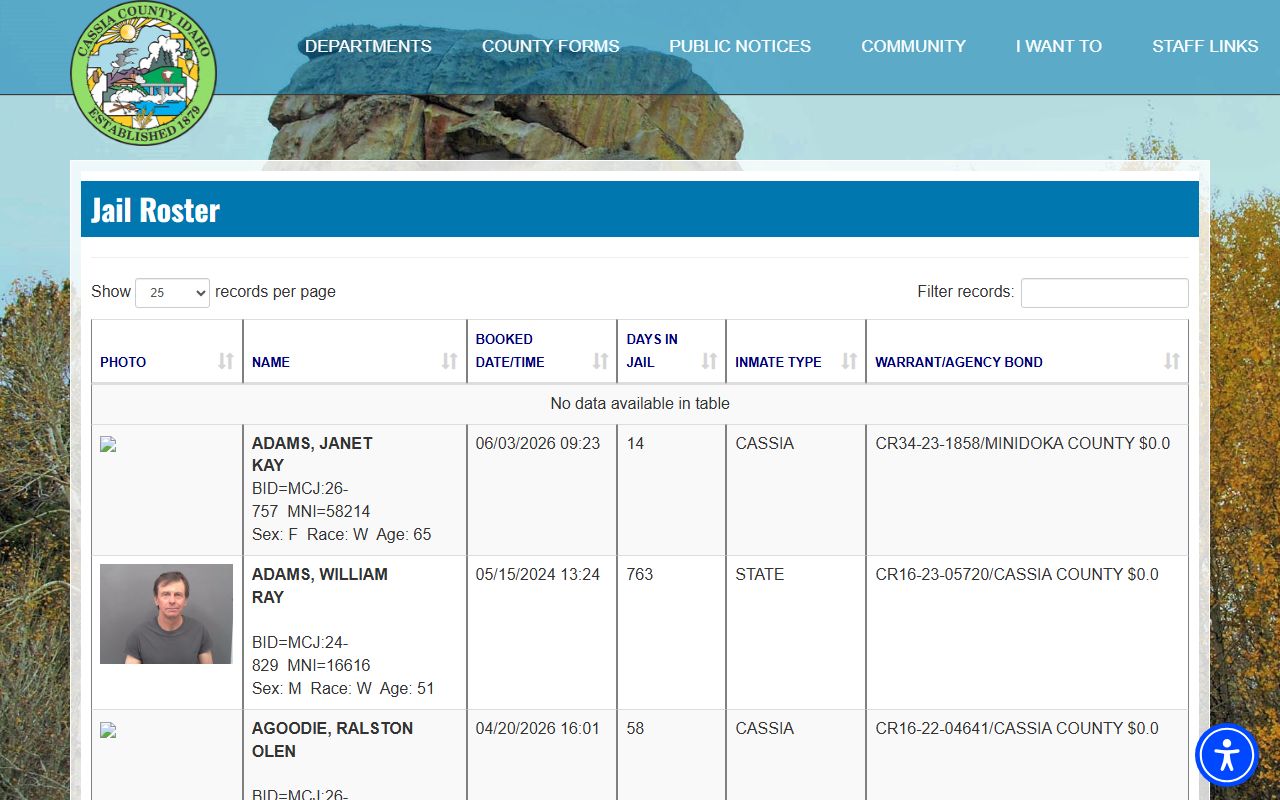
If the roster shows multiple cases, separate each case number before searching iCourt. One arrest can produce several charge lines, and one person can be held for Cassia, Minidoka, state, federal, or other agency matters.
How Charges Get Filed After an Arrest
The booking process records a custody event; the charging process creates the court accusation. In Cassia County, the prosecutor's office files and prosecutes criminal charges after a referral from law enforcement. Booking and jail records may show arrest charges before final charging decisions, while iCourt and the court file show the formal charges, later amendments, pleas, dismissals, dispositions, and sentences.
| Document | Who Uses It | What It Usually Shows | Cassia Search Tip |
|---|---|---|---|
| Complaint | Prosecutor or officer-supported filing | Initial criminal accusation, statute, description, and probable-cause basis. | Common starting point for lower-level criminal matters and early felony proceedings. |
| Information | Prosecutor | Formal prosecutor-filed charge document used in many felony prosecutions. | Look for amended information entries when charges change after first appearance or preliminary proceedings. |
| Indictment | Grand jury | Formal charge returned by a grand jury. | Less common in routine local booking searches, but still a court charging document when used. |
| Citation | Law enforcement, then court | Written charge or ticket, often for traffic or lower-level offenses. | Cassia Magistrate Court warns that failing to appear on citations may result in further action and a warrant. |
Charge Status and What It Means
Charge status can change quickly after an arrest. A recent-bookings entry may show the suspected offense at intake, while the case record may later show a different charge, a dismissal, a plea, or a sentence. Idaho iCourt public access can show party indexes, new filings, chronological case summaries, public calendars, pending and closed status, and hearing information when those records are electronic and not restricted under Idaho Court Administrative Rule 32.
| Status | What It Means | Where to Confirm |
|---|---|---|
| Pending | The charge has been filed or is active and has not reached final disposition. | iCourt case summary or Clerk of the District Court. |
| Amended | The prosecutor or court record changed the charge, statute, level, or wording. | Charging document entries and later docket events. |
| Reduced | A felony may become a misdemeanor, or a higher charge may be replaced by a lower one. | Plea, amended charge, or disposition lines in the court file. |
| Dismissed | That charge ended without a conviction on that count. | Disposition entries, signed orders, or clerk copies. |
| Warrant or FTA | A failure to appear or violation event may create a bench warrant or custody hold. | iCourt, warrant records, dispatch confirmation, or court phone 208-878-7351. |
Charges vs. Convictions
A charge is an accusation. A conviction is an outcome after a guilty plea, finding, or verdict. Cassia County arrest records and booking listings should not be read as proof that a person was convicted. Even a court charge record may show accusations that were later dismissed, changed, or resolved differently.
| Charge | Conviction | |
|---|---|---|
| Stage | Accusation filed or listed after arrest. | Final finding, verdict, or accepted plea on a charge. |
| Record source | Booking list, jail roster, complaint, citation, information, or indictment. | Disposition, judgment, sentence, and related court orders. |
| Proof level | May be based on probable cause or prosecutor filing decision. | Requires plea or proof under the criminal standard. |
| Best Cassia check | Recent bookings, roster, iCourt, and prosecutor-filed documents. | iCourt disposition, clerk copies, sentencing orders, and criminal case file. |
Bonds, Holds, and Court Follow-Up
Cassia jail roster examples show bond amounts by case or charge line, including amounts such as $0.0, $100, $250, $1,000, $25,000, and $75,000. The Mini-Cassia Public Defender page gives a local warning about reading those lines: "$0.0" may mean a probation-violation no-bond hold, a person serving a sentence, or one count showing zero because a different count in the same case carries the actual bond.
For that reason, a bond line should be treated as a custody clue, not as a complete release instruction. Confirm current custody with the Mini-Cassia Criminal Justice Center at 208-878-1000. Confirm court dates, charging documents, and case status with iCourt or the Cassia County Judicial Center at 208-878-7351. If the issue involves a warrant or failure to appear, dispatch at 208-878-2251 is the safer confirmation route before anyone relies on an online list.
Sheriff Records and Prosecutor Records
The Cassia County Sheriff's law enforcement page identifies Sheriff Jarrod Thompson and publishes direct public-safety phone lines, including records at 208-878-1107, investigations at 208-878-1106, civil services at 208-878-2252, Crime Stoppers at 208-878-2900, and jail at 208-878-1000.
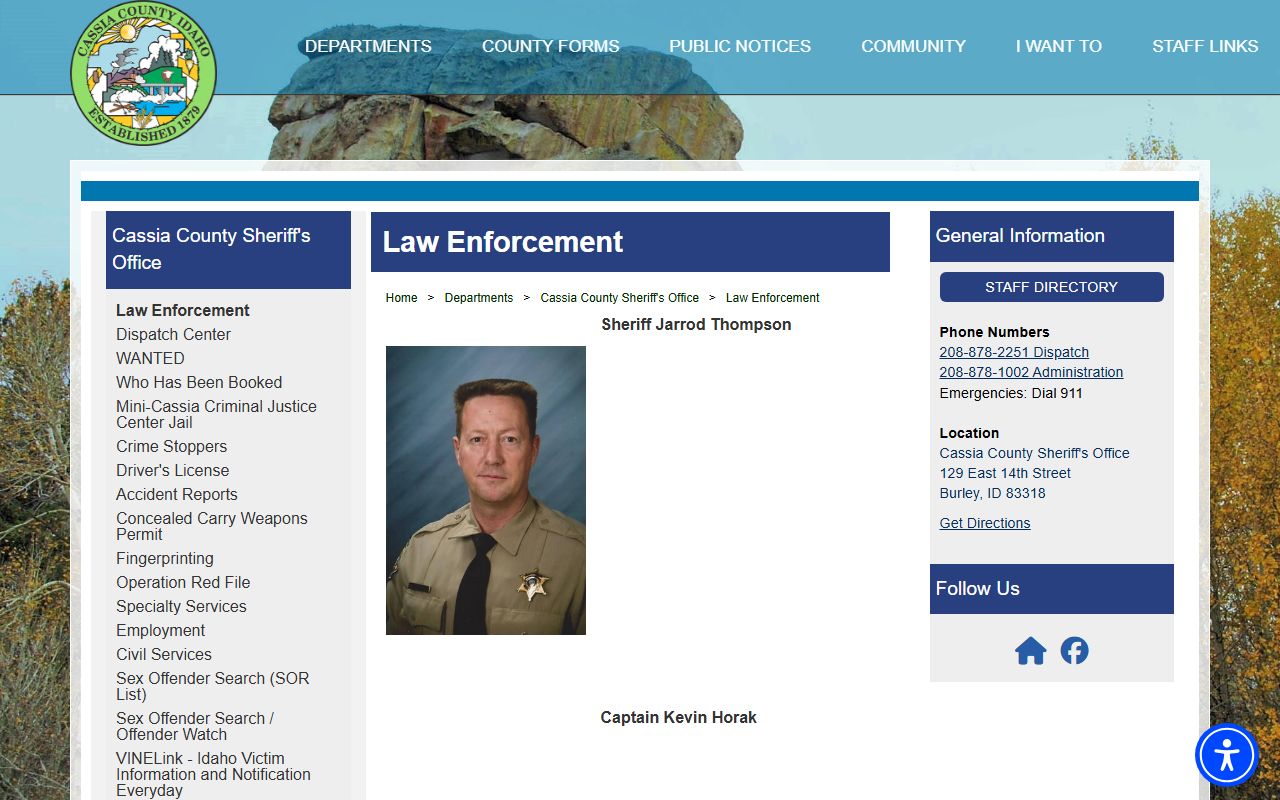
Sheriff records can help with reports, jail status, arrest records, and booking information. Prosecution office records are a separate custodian category on Cassia's public-records form. The county custodian list routes law-enforcement and jail records to the sheriff, prosecution files and reports to the prosecutor, and court records to court@cassia.idcourts.gov.
The Sheriff's Office page also anchors arrest-record users to the correct building: 129 East 14th Street in Burley, separate from the Judicial Center and separate from the Mini-Cassia Criminal Justice Center.
That building split matters. Jail status is confirmed through the jail, court charges are confirmed through iCourt or the clerk, and prosecutor-held records are not the same as a public court docket.
Statewide Charge and Criminal History Lookups
Idaho public court access is governed by a mix of public-records law and court administrative rules. Idaho Code 74-102 recognizes a right to examine and copy public records unless an exception applies. Idaho Code 74-103 governs agency response timing, and Idaho Code 74-104 recognizes exemptions, including records exempt under other statutes and court files of judicial proceedings. Court records are also controlled by Idaho Court Administrative Rule 32.
Statewide court case information should be searched through Idaho iCourt. Public users generally do not need registration for ordinary public access, but extended access requires approval. State criminal-history or law-enforcement checks are different from a Cassia court charge lookup and may be subject to separate state rules under Idaho Code 67-3004.
Sealed vs. Expunged Charge Records
A public search may show limited results when a Cassia charge record is sealed, shielded, or otherwise restricted. The practical route starts with the exact case number, disposition, sentence or probation status, and the legal basis for relief. A public-records request does not itself seal a case; the public display changes only if the court enters a qualifying order.
| Sealed or Shielded | Expunged or Limited Access | |
|---|---|---|
| Public visibility | Hidden or limited in ordinary public access under rule, statute, or court order. | Removed, shielded, or limited from public dissemination when a qualifying law or order applies. |
| Where handled | The Idaho trial court that handled the case, not the jail roster. | The court or state criminal-history process tied to the specific statute and order. |
| Who may still see it | Some officials or approved extended-access users may retain access under ICAR 32. | Access depends on the relief granted and the record system involved. |
Restricted Charge Records in Cassia County
Not every arrest or charge detail is public. Juvenile matters are handled in the Magistrate Division, and Idaho Code 20-525 controls privileged juvenile information. Public iCourt access does not show Social Security numbers, addresses, telephone numbers, driver's license numbers, financial-account numbers, and similar personal identifiers. Some family, protection, sealed, shielded, adoption, and minor-related records may be limited under ICAR 32 or by court order.
Important: This site is not a consumer reporting agency and cannot be used for FCRA-regulated screening decisions.