
Cassia County Criminal Case Files
A Cassia County criminal court record is the court case file maintained after a prosecutor files a criminal charge in Idaho's trial court system. It is broader than an arrest record. It can show the charging document, arraignment, plea, pretrial motions, hearing settings, warrant events, bond orders, dismissals, amendments, verdict, disposition, sentence, probation terms, and court financial obligations. The court case file is the place to confirm what happened after law enforcement or jail records first listed an arrest or charge.
Criminal cases in Cassia County are handled within Idaho's District Court structure. District Court handles general trial-court matters and felony criminal cases. The Magistrate Division operates within District Court and handles traffic, citations, lower-level criminal matters, juvenile court, small claims, probate, and other magistrate work. Both District Court and Magistrate Court services are centered at the Cassia County Judicial Center, 1559 Overland Ave, Burley, ID 83318, with court phone 208-878-7351 and court email court@cassia.idcourts.gov.
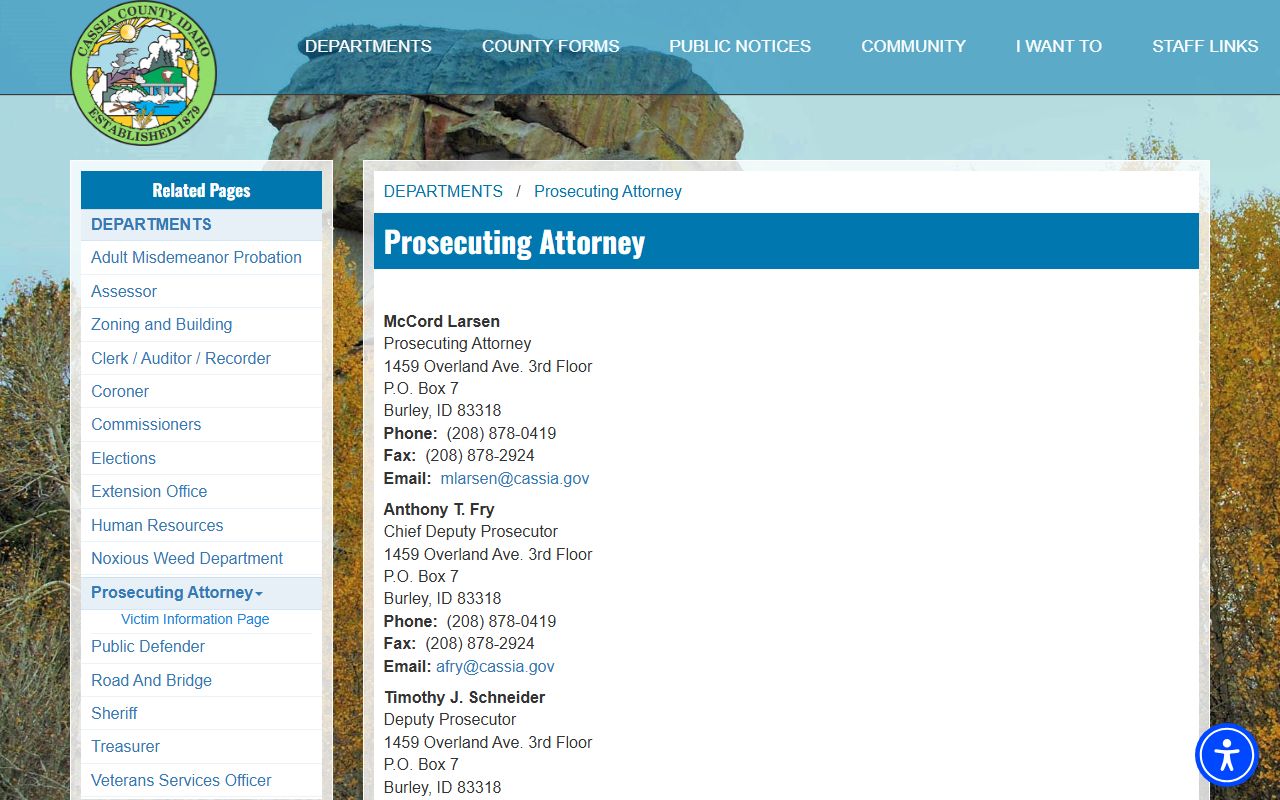
The Cassia County Prosecuting Attorney page identifies the local office that prosecutes criminal cases after law-enforcement referral.
Search Cassia County Criminal Court Records
The main online route is the Idaho iCourt system and the public iCourt Portal. Idaho says the portal lets users view case information, search hearings, and make payments. For Cassia County criminal court records, Smart Search is useful when a defendant name or case number is known. Search Hearings is useful when the goal is to confirm a criminal court date or docket setting.
Public users do not need to register for ordinary access. Extended access requires registration, verification, agency approval where applicable, and review under Idaho Court Administrative Rule 32. If a criminal case is not visible, the reason may be age, data limits, sealed status, juvenile confidentiality, recent filing lag, or use of another county's case number. Public iCourt is an index and docket route, not a guarantee that every document will be viewable.
- Open Idaho iCourt and choose the public case-search portal.
- Search by defendant name, case number, or record number. Use Cassia County or Fifth Judicial District filters if shown.
- Review the case type, status, charge description, court division, and docket entries before relying on the match.
- Use Search Hearings to confirm arraignments, pretrial conferences, trials, sentencing dates, or later review hearings.
- Request copies or certified records from the Clerk of the District Court if the full file or a document is needed.
A criminal case lookup should not be confused with the jail roster. The roster may show current custody, bonds, or booking identifiers, while the criminal court file shows formal court events and outcomes. For a closer look at charges after arrest, use the Cassia County arrest records and court charges material rather than treating a booking list as the final case record.
Cassia County Criminal Case Flow
Criminal court records are easiest to read when the docket is viewed as a sequence. A case may start with a complaint, information, indictment, or citation depending on the charge type. The prosecutor's filing sets out the formal accusation. The arraignment addresses the charge and plea. Pretrial entries can include motions, bond orders, warrants, continuances, discovery disputes, and hearing notices. The case then moves toward a plea, trial, dismissal, or other disposition, followed by sentencing if there is a conviction.
Case flow: Charges Filed › Arraignment › Pretrial / Motions › Plea or Trial › Disposition › Sentencing
- Charges filed
- The prosecutor files or pursues the formal criminal charge. Jail booking charges may change at this stage.
- Arraignment
- The defendant is advised of the charge and enters or addresses a plea under court procedure.
- Pretrial / motions
- The docket may show motions, hearings, bond changes, discovery issues, continuances, or warrant events.
- Plea or trial
- The case may resolve by plea, trial verdict, dismissal, reduction, amendment, or other court action.
- Disposition
- The court records the outcome of the case or each charge, such as guilty, dismissed, acquitted, or amended.
- Sentencing
- If there is a conviction, the court enters jail, prison, probation, fines, costs, treatment, or other terms.
The Mini-Cassia Public Defender Office is a court-appointed defense resource, not a public records office. Its local role matters because appointment, bond issues, and case status often affect how defendants interact with the court file.
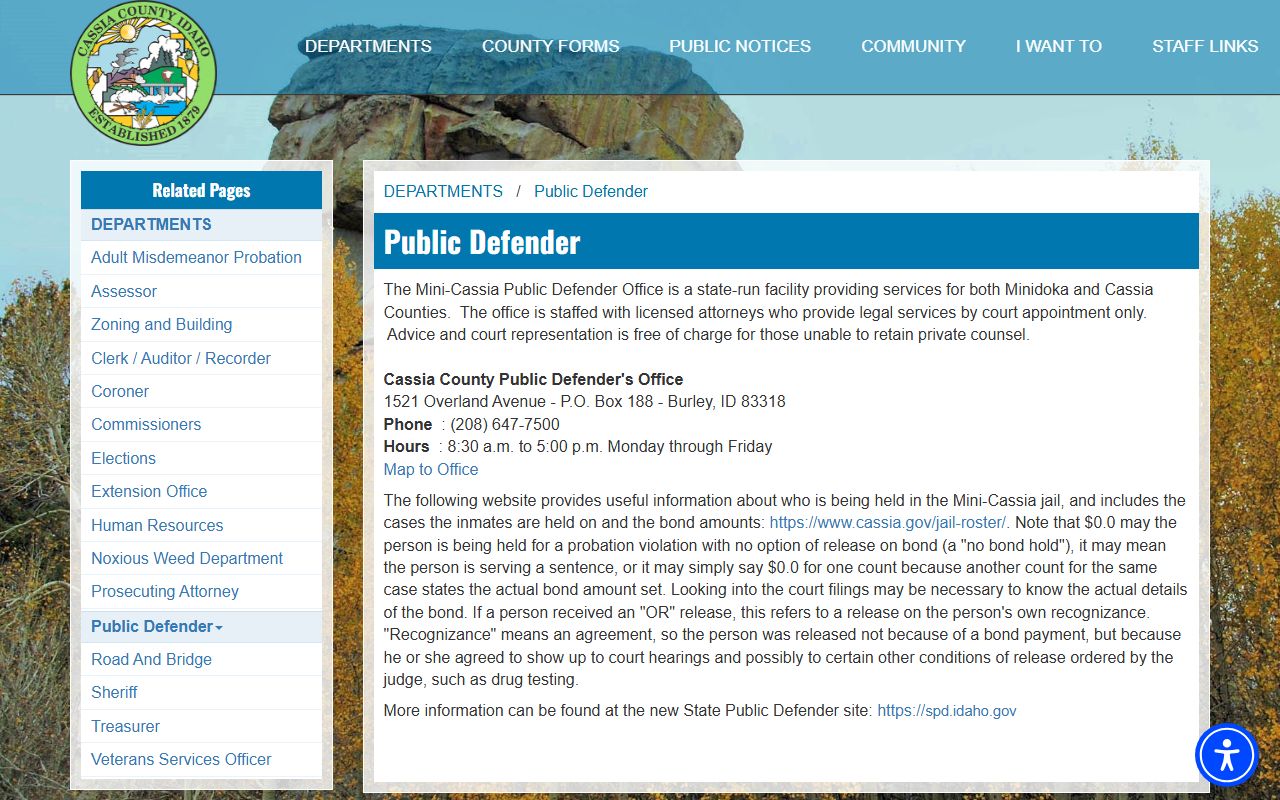
The Mini-Cassia Public Defender page explains appointment-only representation for eligible defendants.
Cassia County Criminal Court Fields
A criminal court record can include several types of public data. Idaho iCourt may show party indexes, new filings, chronological case summaries, dockets, calendars, pending status, and closed status when the record is electronic and public. Cassia jail and booking pages can provide related charge codes and case numbers, but those lists do not replace the court file. The court record is the source for pleas, dispositions, and sentencing.
| Field | What It Shows |
|---|---|
| Case number | The court identifier used for docket lookup, payments, clerk requests, and hearing searches. |
| Defendant | The person accused in the criminal case, subject to public access and redaction limits. |
| Prosecuting party | Usually the State of Idaho in a criminal case, with prosecution handled by the local prosecutor. |
| Charges | Statute code, charge description, and felony or misdemeanor level where public. |
| Arraignment | The early court event where the charge and plea process are addressed. |
| Plea | The defendant's response to a charge, such as guilty, not guilty, or another recognized plea entry. |
| Motions and orders | Requests by parties and rulings by the judge, sometimes visible only as docket entries. |
| Warrants and FTA entries | Bench warrants, failure-to-appear events, or probation violation notes when part of the public case. |
| Disposition | The outcome of the case or charge, including conviction, dismissal, acquittal, or amendment. |
| Sentence | Jail, prison, probation, fines, costs, treatment, or other terms after conviction. |
| Bond / financial data | Bond orders, fines, fees, or other obligations if they are part of the public court record. |
The public display does not include Social Security numbers, addresses, phone numbers, driver's license numbers, financial-account numbers, or similar personal identifiers. A record may still exist even when the public view is limited.
Cassia County Charges vs Convictions
A charge is an accusation filed or pursued in court. A conviction is an outcome after a guilty plea, verdict, or other qualifying court finding. Cassia County criminal court records can show charges that were dismissed, reduced, amended, or ended without conviction. That is why users should read the disposition and sentence fields before treating a charge line as a final result.
Booking pages and jail rosters may show initial charge data quickly, but prosecutor decisions and court outcomes can change the case. The prosecutor files and prosecutes criminal charges after law enforcement refers an arrest or investigation. The court file then shows the official charges, amendments, pleas, dismissals, dispositions, and sentencing terms.
| Charge | Conviction | |
|---|---|---|
| Meaning | An accusation or filed count in a criminal case. | A final finding or plea that establishes guilt on a count. |
| Case stage | Appears early and may be amended, reduced, or dismissed. | Appears after plea, verdict, or another qualifying disposition. |
| Record use | Shows what was alleged or filed. | Shows the outcome that can support sentencing and later consequences. |
| Caution | Do not treat as proof of guilt. | Still check sentence, appeal, sealing, or later court orders. |
Cassia County Criminal Dispositions
Disposition means the outcome of a case or charge. A criminal docket may show a case as pending, closed, dismissed, amended, guilty, not guilty, acquitted, or otherwise resolved. Sentence means the punishment or court terms imposed after conviction. Sentence entries can include jail, prison, probation, parole-related status after state custody, fines, costs, treatment, no-contact terms, or other orders.
Cassia's jail roster and public defender materials add a local caution for bond and custody readings. The Public Defender page explains that "$0.0" on the jail roster can have more than one meaning. It may reflect a probation-violation no-bond hold, a sentence, or one count showing zero while another count carries the actual bond. That roster note helps prevent a common error: reading a custody field as if it were a final court sentence.
Note: Read charge, disposition, sentence, and later orders together before drawing conclusions from one docket line.
Cassia County Criminal Sealed Records
Restricted criminal court records are governed by Idaho court rules, statutes, and court orders. Idaho Court Administrative Rule 32 governs judicial record access. Idaho Code 67-3004 is relevant to criminal-history records and the shielding of qualifying criminal records. Juvenile cases also need special care because Cassia Magistrate Court handles juvenile court and Idaho Code 20-525 controls juvenile records and privileged information.
| Sealed or Shielded | Expunged / Removed | |
|---|---|---|
| Public view | Hidden or limited in ordinary public access after a rule, statute, or court order applies. | Removed or treated as unavailable in the way Idaho law permits for the record type. |
| Who may see it | Some parties, attorneys, officials, or extended-access users may retain access under ICAR 32. | Access depends on the law and order governing the specific record. |
| How it changes | A court order or qualifying statutory process changes public display. | A qualifying statutory or court process controls removal or shielding. |
| Public-records form | Can request existing records but does not itself seal or unseal a case. | Does not replace a motion, petition, or statutory process. |
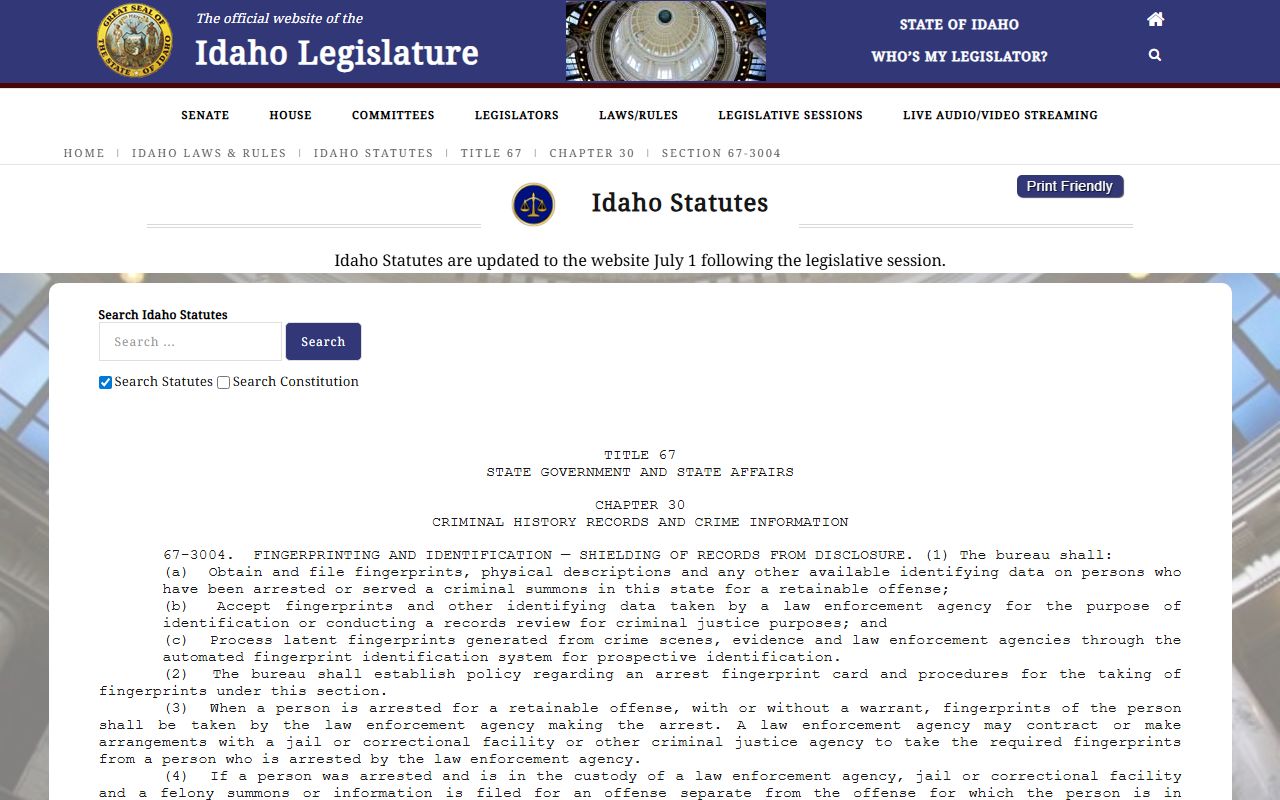
The Idaho criminal-history statute is one source for shielding and dissemination rules.
Cassia County Criminal Court Access
Public access starts with iCourt for case information and hearings. Copies, certified copies, older files, and documents not visible online go through Joseph W. Larsen, Clerk of the District Court. Cassia's court-records request page requires the county request form to be signed, completed in full, clear about the purpose and records requested, and emailed to court@cassia.idcourts.gov. Bulk court-record requests are referred to the Idaho Supreme Court rather than handled as ordinary local clerk requests.
Idaho public-records law supports access, but criminal court files are still subject to court-record rules. Idaho Code 74-102 states the right to examine and copy public records unless an exception applies. Idaho Code 74-104 recognizes exemptions and court-file limits. ICAR 32 governs judicial records and explains why access may differ for public users, parties, attorneys, and approved officials.
Key Statutes:
Idaho Code 74-102 gives a general right to examine and copy public records unless an exception applies.
Idaho Code 74-104 recognizes exemptions, including records controlled by other statutes or judicial rules.
Cassia County Criminal Court Context
Some public safety sources help explain a criminal court record, but they do not replace it. Sheriff Jarrod Thompson's county law-enforcement resources link jail, booking, warrant, registry, and notification tools. Cassia's recent bookings page can show booking date, name, sex, race, age, charge code, statute, charge description, and felony or misdemeanor level. The jail roster can show booking identifier, MNI, agency, case number, court or county label, and bond amount. These fields can help locate a court case, but they are not the full criminal case file.
The Idaho State Police sex offender registry and Idaho VINELink are separate statewide tools. A registry listing, custody notification, or jail roster entry may relate to a criminal case, but each has its own purpose. Use iCourt or the clerk for the criminal court file, use jail records for current local custody, use IDOC for state custody or supervision, and use official registry or victim notification tools only for those specific functions.
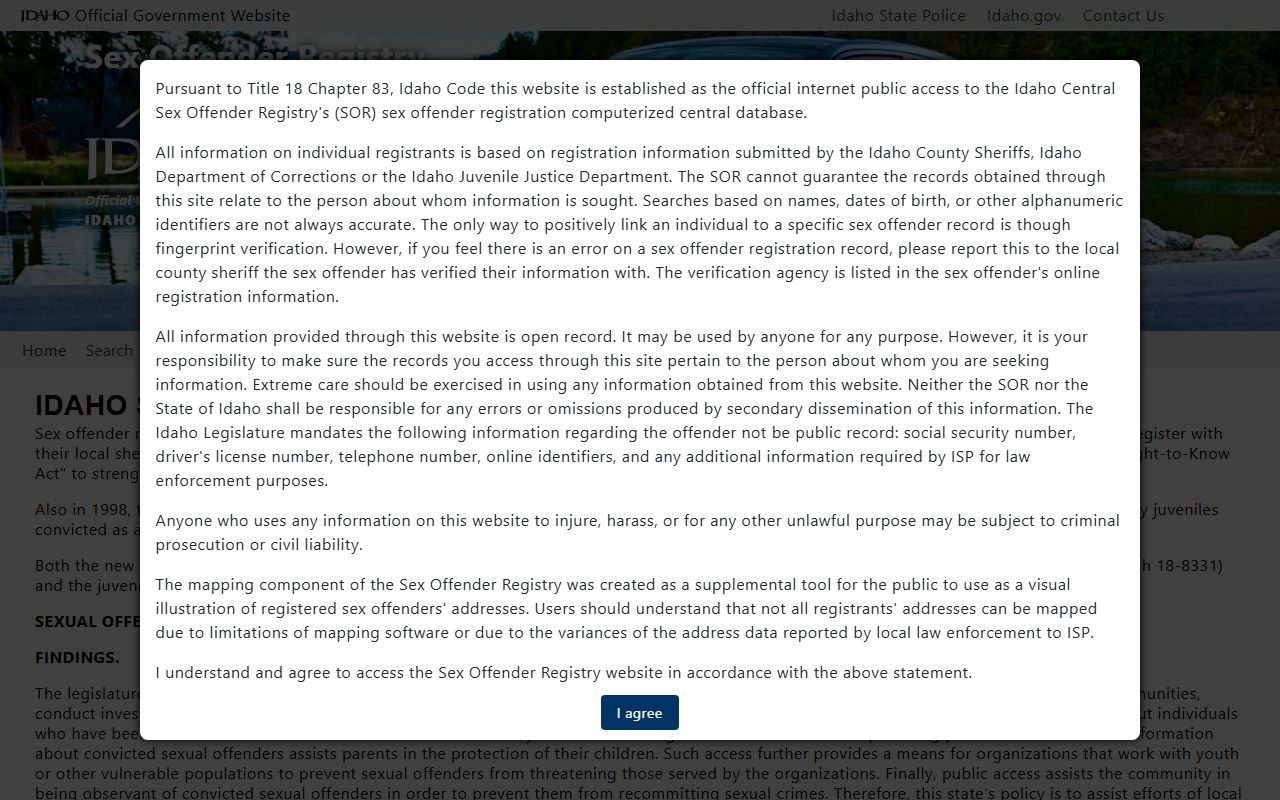
The Idaho State Police sex offender registry is linked by Cassia sheriff resources but is separate from the court case file.
Idaho VINELink provides victim notification and custody or case alerts for Idaho.

Cassia County Criminal Court Restrictions
Restricted Cassia County criminal court records include juvenile matters, sealed or shielded cases, certain confidential family or protection-order details, mental-health-related records, and personal identifiers. A public search may show only part of a case, no document images, or no result at all. That does not always mean the case never existed.
A person seeking access to a restricted case should identify the case number, party names, disposition, sentence or probation status, and the legal basis for access. Party status, attorney status, a court order, guardianship, agency role, or another authorization may matter. The request starts with the Clerk of the District Court, but changing public access requires a court process, not a simple records request.
Clerk of the District Court
Joseph W. Larsen
Cassia County Judicial Center
1559 Overland Ave
Burley, ID 83318
208-878-7351
court@cassia.idcourts.gov